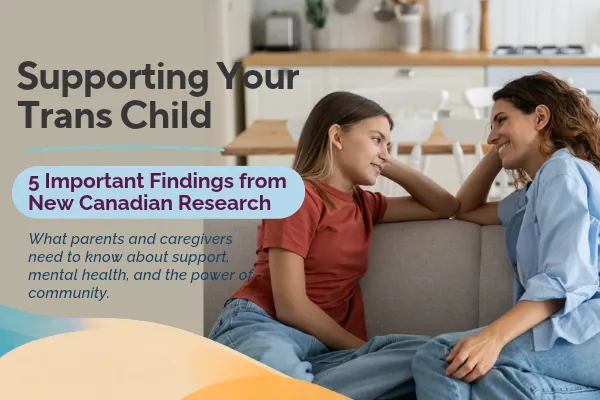
Supporting Your Trans Child: 5 Important Findings from New Canadian Research
Supporting Your Trans Child: 5 Important Findings from New Canadian Research
What parents and caregivers need to know about support, mental health and the power of community.
A new Canadian report offers an encouraging reminder for parents and caregivers of transgender and nonbinary youth: Your support matters more than you might realize.
What if one of the most powerful things you can do for your transgender or nonbinary child is something you are already doing — showing up, listening and learning?
If you're parenting a trans or nonbinary child, you've probably had moments of uncertainty.
Am I doing enough?
What if I say the wrong thing?
How do I protect my child from the things happening outside our home?
These are questions I've heard from parents and caregivers over the years. They're also questions I've asked myself.
On October 20, 2026, the Royal Society of Canada released an important new research report, The Health and Well-Being of Trans and Nonbinary Youth in Canada.
The report brings together research on mental health, family support, school environments and gender-affirming care.
And while some findings highlight the very real challenges our young people face, there's also a powerful message of hope.
Support matters. Environments matter. And none of us needs to have all the answers to make a meaningful difference.
Here are five important takeaways, I believe every parent and caregiver should know. You can also watch my research finding summary video below.
1. Parental support is one of the strongest protective factors
Let's begin with something encouraging.
Research continues to show that parental support plays a significant role in protecting the mental health and well-being of transgender and nonbinary youth.
When young people feel accepted, respected and supported at home, it can make a meaningful difference in their lives.
But here's what I want parents to hear:
Being supportive doesn't mean having all the answers.
It doesn't mean you'll never make a mistake, feel worried or have questions of your own.
It means remaining curious. Listening. Making space for conversations. And reminding your child that your love isn't conditional on how quickly you understand everything.
Sometimes the most powerful thing we can offer is a simple message:
I'm here. I love you. We'll figure this out together.
2. Being transgender isn't what causes poor mental health
This is such an important distinction.
The report reinforces that the higher rates of anxiety, depression and psychological distress experienced by trans and nonbinary youth are not inherent to their gender identities.
Instead, stigma, discrimination, bullying and hostile social environments are major contributors.
Think about what that means.
Rather than asking what's wrong with our children, we need to ask what is happening around them.
Are they experiencing bullying at school? Do they feel safe participating in sports? Are they worried about being judged or rejected?
Understanding the difference between identity and the impact of discrimination changes where we focus our attention.
Our children aren't the problem. The barriers they encounter deserve our attention.
3. Affirming environments build resilience
One of the most encouraging messages in the report is that supportive environments can make a real difference.
When trans and nonbinary youth experience affirmation from their families, schools and healthcare providers, mental health disparities can decrease substantially.
This is about more than using the right name or pronouns, although those everyday acts of respect are important.
It's about creating spaces where young people feel safe enough to participate, ask questions, express themselves and simply be kids.
An affirming environment doesn't need to be perfect.
But it does need people who care enough to learn, listen and take action when something isn't right.
4. Families shouldn't have to carry the responsibility alone
This is one of the findings I most want parents and community leaders to hear.
Yes, parental support is incredibly important.
But our children don't spend their entire lives at home.
They go to school. Join teams. Attend camps. Visit recreation centres. Spend time with friends. And participate in their communities.
The report identifies supportive school staff, peers, inclusive policies and safer school environments as important contributors to young people's well-being.
This tells us something significant.
Supporting our kids doesn't mean having to fight every battle alone. It's also about finding the people and places that will stand alongside them.
A coach who intervenes when a player is excluded.
A teacher who respectfully uses a student's name.
A camp counsellor who knows how to respond when someone makes a hurtful comment.
A recreation manager who ensures all children can participate safely.
These everyday actions matter.
And as parents, we can advocate for those environments while recognizing that creating them is a shared responsibility.
5. Gender-affirming care is individualized — not one predetermined pathway
There is no single journey that every trans or nonbinary young person follows.
Some may benefit from social affirmation, such as changes to names, pronouns or gender expression. Others may seek medical care as part of their individual needs.
The report reviews evidence supporting the benefits of gender-affirming medical care for young people who need it.
Importantly, supporting a child does not mean assuming they will follow a particular medical pathway.
It means listening to their experiences, respecting their individuality and seeking appropriate guidance from qualified healthcare professionals when needed.
Every young person deserves care that takes their circumstances, needs and well-being seriously.
And every family deserves access to trustworthy information to help them navigate those conversations.
What this research reminds us
When my own child came out, I didn't have a roadmap.
I had questions. I had fears. And I had a whole lot to learn.
What I did know was that I wanted my child to feel loved, supported and safe being himself.
Over time, I've learned that supporting our children isn't about getting everything right the first time.
It's about continuing to show up.
It's also about recognizing that we need supportive schools, knowledgeable professionals and welcoming communities working alongside us.
When families and communities work together, we create better conditions for our young people to thrive.
And that is something worth building.
Watch: The 5 Key Research Findings Explained
I've recorded a short video walking through these five findings and what they mean for parents and caregivers.
My hope is that it helps you feel a little more informed, a little more confident and perhaps a little less alone.
You don't have to navigate this alone
If you're parenting or caring for a trans or nonbinary loved one and would appreciate a space to ask questions, share experiences and learn alongside others, I invite you to join our private online parent and caregiver community.
It's a place for connection, practical resources and conversations grounded in compassion and understanding.
Join Our Private Parent & Caregiver Community
Because sometimes support begins with knowing there are others walking alongside you.
Research source:
Pullen Sansfaçon, A., Geoffroy, M.-C., Mizzi, R. C., Bernheim, E., & Weinberg, A. (2026). The Health and Well-Being of Trans and Nonbinary Youth in Canada. Royal Society of Canada.
https://rsc-src.ca/en/research-and-reports/health-and-well-being-trans-and-nonbinary-youth-in-canada


